
Movement
Calibre 22A
← Back to all Calibres1945 – 1957
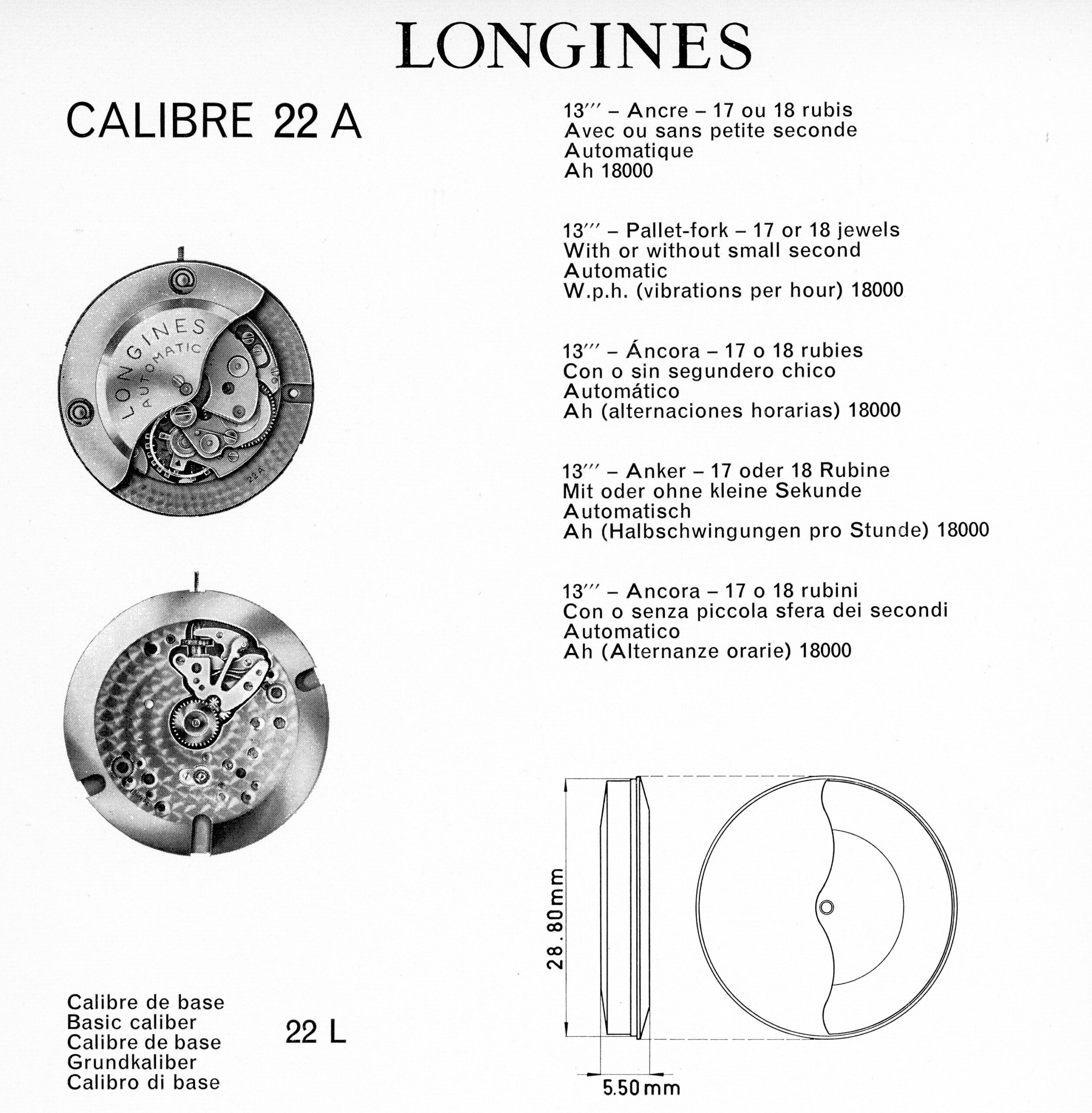 ⤢ enlarge
Technical Diagram
Notes
During the war years, the bulk of Longines energy and expenditures went to optimizing the production of their existing movements demand for which was close to insatiable during the early war years. In 1942 and 1943, Longines produced 200,000 watches each year and with less staff than prior to the war. By 1944 however as it became increasingly apparent that the course of the war was favoring the allies, Longines was able to begin conceptualizing what its postwar offerings would be. One of the two major projects was a new chronograph movement to replace the 13ZN which would become the 30CH. The other was the bi-directional self winding 22A calibre. Longines was a latecomer to the self winding movement. In the prewar years, there were several attempts and experimentations with self-winding movements, most of which were technical failures that were mechanically unreliable or unrealistic to produce at scale, the notable exception being Rolex's patented self-winding uni-directional movements which had been produced at scale and reliably since the early 1930s. Omega released its first mass-produced self-winding "bumper movement" in 1943 but this was considered an inferior product to Rolex's system as well as Felsa's bi-directional self-winding system by the Longines technical team. Thus, as design work began on longines first self-winding calibre, the goal was laid out explicitly to make a bi-directional self-winding calibre which was aimed at the top of the market in terms of technology. Six early prototypes of the 22A were completed in 1944 (Serial numbered 6999999) but much time was spent in development figuring out the right gearing, oiling, and shock dampening for the automatic winding works. Mainline production would begin in 1945 but would not begin to ramp up until 1946 as postwar civilian markets reopened. The base calibre was also released as a manual wind version, the 22L and in center seconds, the 22N